

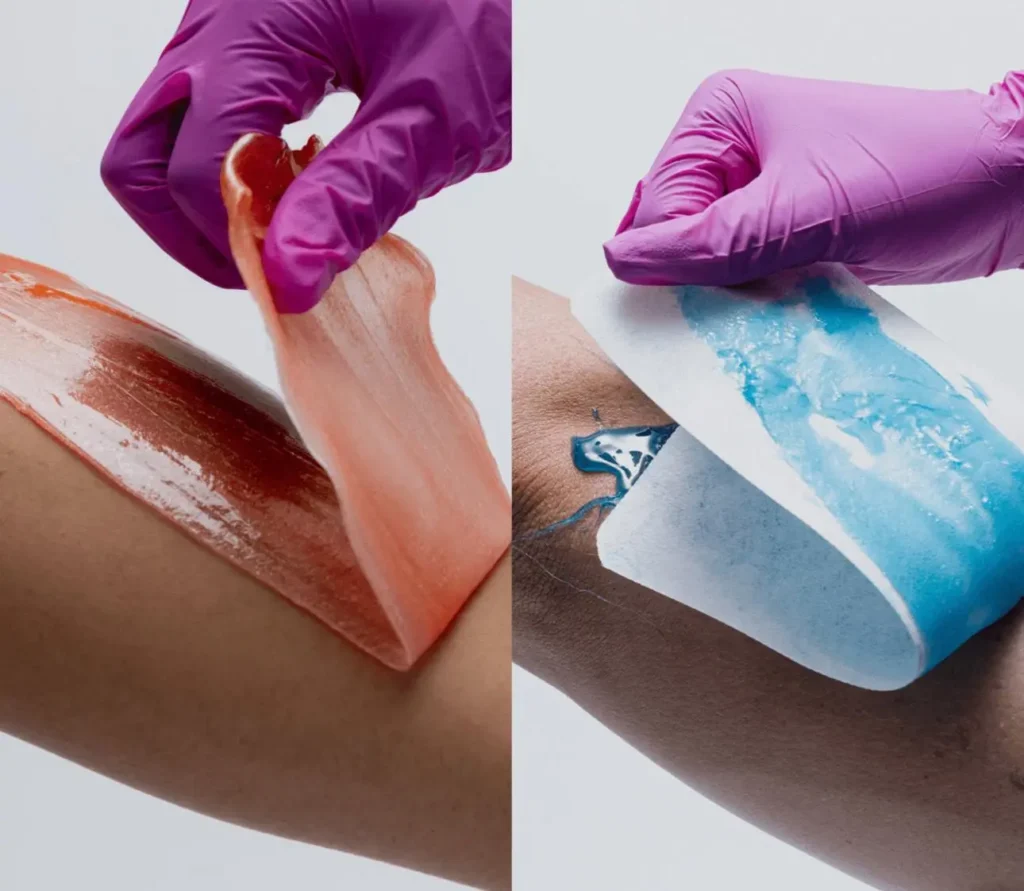
If you’ve ever come out of a wax appointment looking like you got into an argument with a cheese grater, you’ve probably wondered if there’s a better way. There is a way called hard wax, and if nobody’s explained the difference between hard wax and soft wax to you before now, that’s honestly a little on the waxing industry.
If you prefer a sugar-paste method, explore our professional sugaring services in Erie.
So let’s clear it up. Here’s what actually happens to your skin with each type of wax, why it matters if you bruise easily or react to everything, and which one we reach for when someone tells us “I have sensitive skin” before they even sit down.
What’s the Actual Difference?
Soft wax is the thin layer of warm wax spread onto your skin with a stick, then ripped off with a cloth or paper strip. It grabs hair, but it also grabs a layer of your skin along with it, since it bonds to everything it touches, not just the hair.
Hard wax goes on thicker and is applied without a strip. As it cools, it hardens and shrinks slightly, wrapping tightly around the hair itself rather than gluing itself to your skin. Once it sets, we remove it by hand, pulling it off in the direction that lifts hair out cleanly without dragging across the surrounding skin.
That one difference, hard wax grips the hair instead of the skin, is the entire reason this conversation matters for sensitive skin.
Why Hard Wax Tends to Win for Sensitive Skin
Because hard wax isn’t bonding to your skin the way soft wax does there’s less pulling, less redness, and less of that “my skin is on fire” feeling afterward. A few specific reasons it’s usually the better call for reactive skin
• Less repeated contact Soft wax often needs a second or third pass over the same patch of skin to get every hair. Hard wax is typically a one-pass job, which means less total friction on the area.
• No strip drag Ripping off a cloth strip pulls at a wider stretch of skin than removing hard wax by hand, where we’re working in smaller, more controlled sections.
• Better for coarse or curly hair This is also exactly the hair type most prone to ingrown hairs and irritation, so the gentler removal matters twice as much.
• Fewer broken hairs Soft wax can snap hair instead of pulling the full root, which leads to faster regrowth and more irritation as those hairs work their way back up.
This is exactly why hard wax is the standard choice for the bikini area, underarms, and face here at Honey Bare. Those are the spots where skin is thinnest, hair is often coarser, and nobody wants extra drama.
So Is Soft Wax Just Bad?
No. Soft wax isn’t the villain here, it’s just built for a different job.It covers large, flat areas like legs, arms, and backs quickly and efficiently. That’s exactly what you want when you’re removing hair from an entire leg instead of working through small, more sensitive sections. Used correctly, on the right area, with the right pressure, soft wax is completely fine for plenty of people, including some with sensitive skin.
The problems usually show up when soft wax gets used somewhere it shouldn’t, like a bikini line or underarm, simply because it’s faster or the salon doesn’t stock hard wax. That’s a corner-cutting problem, not a soft wax problem.
Common Signs of Sensitive Skin to Watch For
Some people know exactly what their skin does. Others figure it out the hard way, mid-appointment. A few signs worth paying attention to before you book:
• You get red, irritated, or bumpy after shaving, not just waxing
• New skincare products tend to cause breakouts or reactions
• You bruise easily or your skin stays pink for hours after minor irritation
• You deal with eczema, rosacea, or generally reactive skin in other areas of life
None of this means you can’t wax. It just means it’s worth saying so when you book, so we can plan the appointment around your skin instead of finding out the hard way.
What Actually Helps, Regardless of Wax Type
Even with the right wax, technique and aftercare do a lot of the heavy lifting. A few things that consistently make a real difference:
• Let hair grow to about 1/4 inch Wax that’s too short won’t grip well, which means more passes over the same skin.
• Skip the heavy lotions on appointment day Oils and lotions create a barrier that keeps wax from grabbing hair cleanly the first time.
• Avoid hot showers, workouts, and tight clothing for 24 hours after Freshly waxed skin is more reactive than usual, and heat or friction makes it worse.
• Tell your esthetician what your skin actually does. Not what you think they want to hear. We can’t adjust technique for sensitivity we don’t know about.
The Honey Bare Take
Here’s the short version if your skin tends to react, hard wax is almost always the better choice, especially for the bikini area, underarms, and face. Soft wax has its place on larger areas like legs and arms, but it’s not the move for sensitive spots.
That’s exactly why we offer both hard and soft wax at Honey Bare, and why we don’t default to whichever one is faster or cheaper to use. If you’ve had bad experiences elsewhere, redness that wouldn’t quit, bumps that hung around for days, skin that felt raw for a week, it might not have been you. It might have just been the wrong wax for your skin.
Tell us your skin tends to react when you book. We’ll plan around it instead of finding out mid-appointment.